Essay
We’ve Played This Game Before
A large part of my political science degree was focused on international security policy which at the time, meant nuclear security policy (9/11 was still new enough that terrorism was still just a bolt-on unit at the end—wild to imagine now).
And while I in no way consider myself an expert on the Cold War and nuclear politics, I am aware of some of the striking similarities we’re seeing related to the development of AI. There are also some important differences that I’ll touch on here, but likely need to save for a future post.
The Cold War was characterized by an escalation of arms—each country, fearful that the other would gain nuclear dominance, raced to create bigger and more powerful weapons, ultimately ensuring that should nuclear war ever arrive, life on this planet would cease to exist. This was partially due to a policy of mutually assured destruction, which in a weird twist, turned out to be a key piece in avoiding nuclear war.
The Policy of Mutually Assured Destruction (MAD) was essentially this: If you attack us, we will retaliate. We know you will then retaliate and we will as well, and in the end, we will all be cooked (literally). Because of this reality, both countries never did attack and ultimately agreed to some guardrails and restrictions on nuclear development that are still in place today.
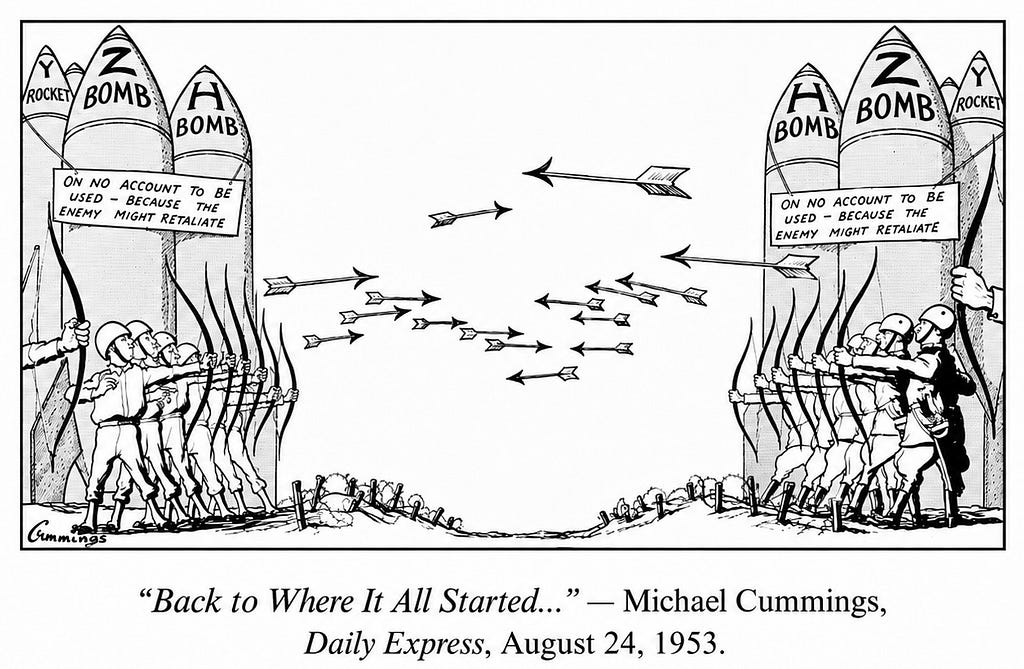
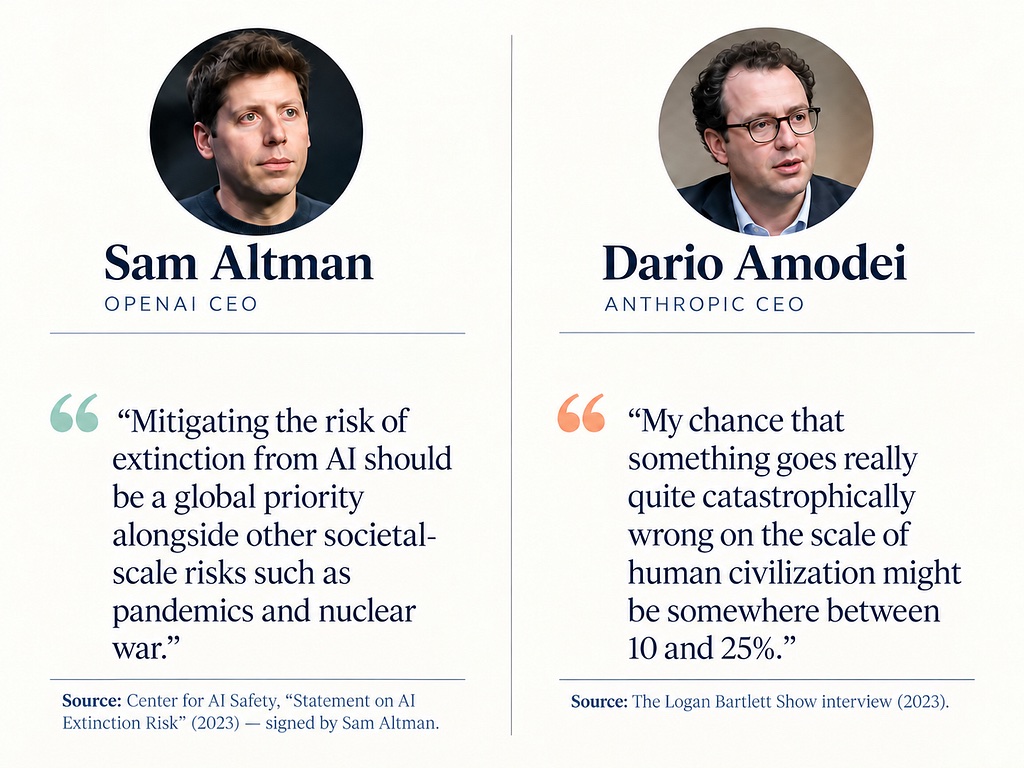
If you’ve read the news lately, we’re seeing a very similar situation among the AI companies. In a race for dominance of the industry, each company is developing smarter and stronger AI models that, in their very own words, threaten the existence of the human race. There are calls on all sides for legislation, or at least an agreement to slow down. But, the threat of losing the race, coupled with geopolitical fears about falling behind other countries (China namely), keep the race moving at a staggering speed.
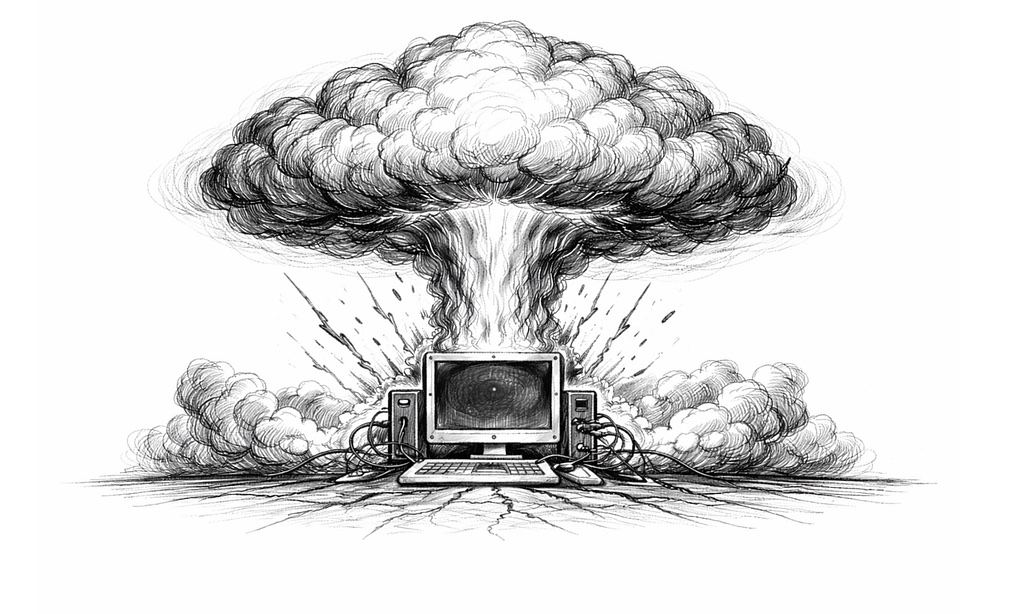
Mutually Assured Destruction by AI, while technically agreed upon, is harder to see in the AI race. How exactly “the computers” are going to destroy humans is still very much up in the air. That makes policy making and agreements potentially harder to come by. We can’t see the end and that fuzziness is challenging. [For more conversation about the fears surrounding AI, might I suggest a recently published book: curiousandconfused.ai]
The scenarios we’re talking about here all fall within a field called Game Theory and many of my college classes spent a lot of time talking about it. It is a fascinating field that applies mathematics to human behavior. It can help us to both predict and explain human behavior in ways that play out in the real world surprisingly accurately.
The good news is that Game Theory gives us ways to approach problems that can otherwise feel impossible. There are ways to structure the “game” in ways that incentivize people, companies, and countries to act in ways that avoid our mutual destruction—and importantly—that don’t rely solely on people’s moral compass.
There are ways to structure the “game” in ways that incentivize people, companies, and countries to act in ways that avoid our mutual destruction—and importantly—that don’t rely solely on people’s moral compass.
There’s a lot more to say about how Game Theory operates, and I’ve long been interested in it. Enough so that I’m writing a fictional(ish) book centered on Game Theory (leave me a comment if you’d like to be an early reader).
One last thing that is oddly comforting to me: many of the policies and agreements that came about surrounding nuclear weapons came about long after we had weapon stockpiles that could destroy the Earth many times over. Prior to that, there were enormous efforts to create bigger and better bombs—and very little restriction. So, while we feel like maybe we should get out ahead of this doomsday scenario, the sad reality of the human race is that we’re much better at dealing with issues when they appear, not beforehand. We prefer firefighting to fire prevention (just check out the multitude of firemen calendars for proof—hah!). We cannot ignore that time is a real factor in all of this (both positively and negatively).
This is not a call to not legislate, to not work towards agreements, and to not maybe slow down just a little, to let us catch our breath before releasing the next mind-blowing model. I’m still impressed I can turn my family into cartoon characters—let me have this moment.

But it is a reminder that we can do hard things, we have done them before, and if we tap into our God-given ability to overcome all the odds, I have faith that we’ll figure this out too.
This essay was also published on Medium.